Play Starts with Parents
Reflections from the Good Start Summit
Last week, Learn To Play had the privilege of attending the Good Start Summit, led by the Van Leer Foundation and Challenge Works - Home of the Longitude Prize alongside an extraordinary group of partners. We were honoured to be one of 22 organisations selected as finalists with our friends at Child's i Foundation , and even more honoured to be in a room filled with people deeply committed to reimagining what it means to support children by first supporting those who care for them.
The central message of the summit was both simple and profound: children are the future, but parents are at the centre of child development. We cannot invest in children well if we do not invest in parents first. Children will only thrive when they are nurtured in well-supported communities.
The diversity of solutions presented was deeply inspiring. From AI-powered digital parenting tools emerging in Latin America, to childcare models in Brazil enabling parents’ personal and professional development, to initiatives championing daily reading rituals with children, to Parent Play Pods in the Philippines. The innovation was wide-ranging and powerful.
We also explored how AI can strengthen frontline systems. Jo from Wysa shared how AI can support both teams and caregivers to build more efficient, responsive systems. From structured system prompts to operational efficiencies, AI, when used ethically and intentionally, can amplify human work rather than replace it. For organisations like ours, the question is not whether to use AI, but how to use it to better support the Mamas and facilitators at the heart of our work.
And in the true spirit of play, instead of notes and minutes to document all the learnings that were shared throughout the summit, we had a fantastically talented graphic recorder immortalise our time together.
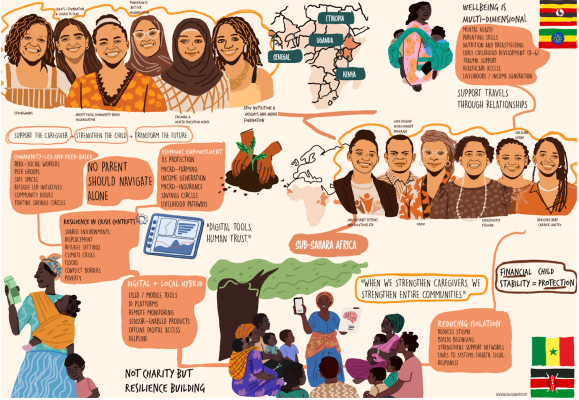 |
The question I kept returning to was: how can we thoughtfully integrate these ideas into LTP’s work? Not to replicate - but to adapt, contextualise, and strengthen what we already know to be true: parents thrive in community.
One of the most impactful sessions was led by Dr. Jodi Pawluski on the parental brain. We explored how parenthood physically changes both the maternal and paternal brain. Oxytocin release, structural size changes, neural rewiring - the biology that enables us to become more attuned, responsive, and connected caregivers.
As a mother myself, I felt deeply seen and validated. When she spoke about what happens in a mother’s brain, especially in the early years, something clicked. The last 12 years of my own motherhood suddenly made sense.
Understanding the neuroscience behind caregiving is not just fascinating. It is empowering. It allows us at Learn To Play to embed scientific backing into our programmes, ensuring that our work is not only heartfelt, but evidence-based and future-facing.
In a storytelling session, we were asked a question that has stayed with me: What is the emotional question you are trying to solve through your work? And what is the emotional answer?
As a mother, my emotional question is often: how do I care for myself while caring for everything around me - my children, my parents, my home, my husband, my team, my organisation, my community? How do I do this without feeling like I am failing?
The emotional answer is this: I feel less lonely in my care when I am in community. When I am with other mothers and other parents. When I feel seen and valued for my care. When I feel safe enough to share my fears and thoughts with a co-parent and the wider circle helping raise my children. When I feel enough.
That reflection led me back to our own work. Through Parent Playbox, how are we helping other parents feel the same? How are we helping them feel enough?
A session led by the BIT (Behavioural Insights Team challenged us to think practically about programme design. Parents carry an incredibly high cognitive load. Decision fatigue is real. Constantly making micro-decisions for children, work, home, and life is exhausting. When that load is heavy, there is less capacity to engage in other areas.
So how do we design programmes that reduce that load rather than add to it? We make participation intuitive. We remove friction before it becomes a barrier. We create shortcuts for engagement. We anticipate behavioural barriers from the outset instead of waiting for them to appear. If we want meaningful engagement, we must design with parents - not for them.
Conversations about scale, sustainability and relationships were equally powerful. One insight resonated strongly: if your work is human-led, your funding strategy must be human-led too. Fund the relationships. Always invest in people. As leaders, we can never delegate our understanding of people or context.
In a strategy session led by Spring Impact , we were reminded to fall in love with the problem, not the solution. What is the problem? What are its root causes and ripple effects? Who does it impact and why should we care? The most powerful insight was this: when you truly love the problem, you are not attached to a single solution. If a solution no longer fits the context, the community, or the moment, you have the courage to let it go. Loving the problem gives you the flexibility to rethink, redesign, and develop new solutions that are better suited, more responsive, and more impactful.
This summit was not just about innovation. It was about affirmation. Affirmation that investing in parents is foundational. Affirmation that science and storytelling belong together. Affirmation that community is not a privilege - it is infrastructure.
As both a leader and a mother, I left with a renewed sense of clarity: when parents feel supported, seen, and less alone in their care, children thrive. And that is the future we are building … together.