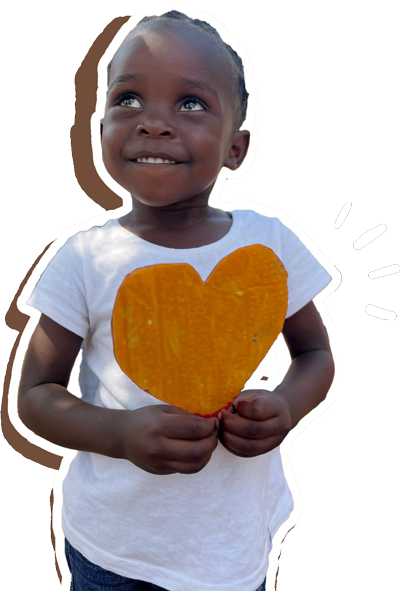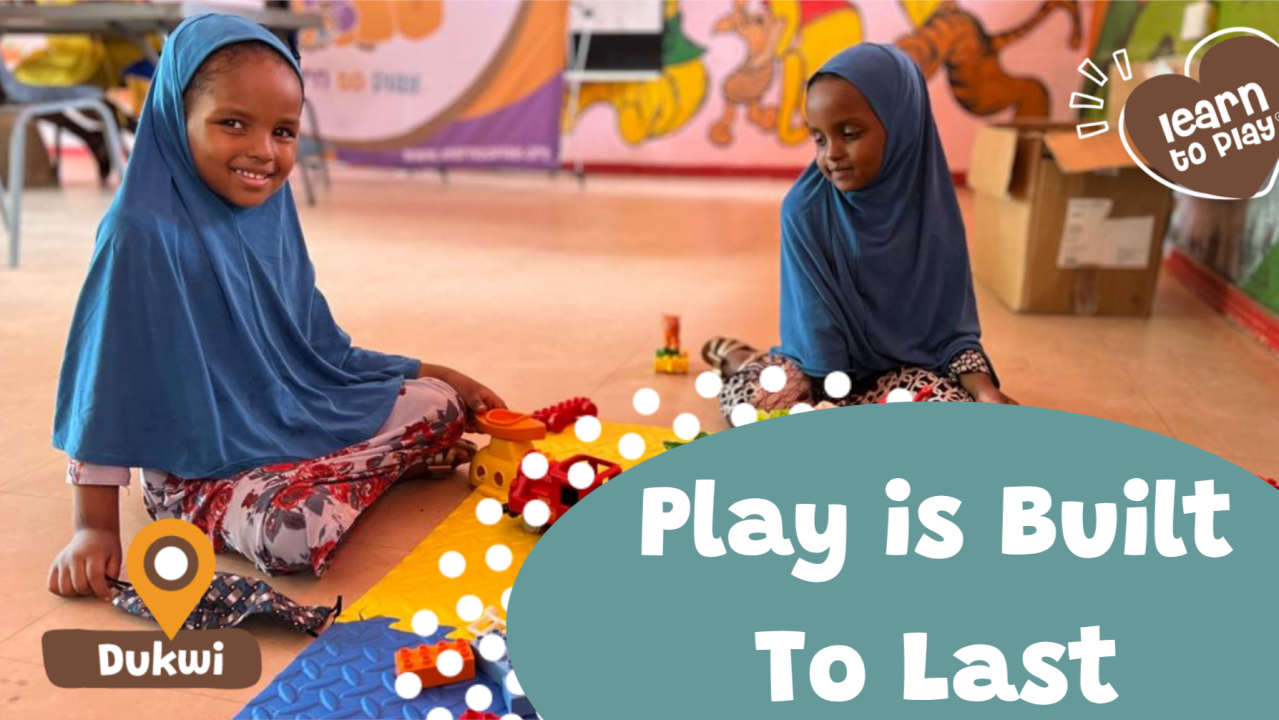
When we hear the words “refugee camp,” most people think temporary. Transitional. In-between. But this isn’t the case at all. Dukwi Refugee Camp sits in the North East District of Botswana, home to families who arrived fleeing conflict in the Democratic Republic of Congo, Rwanda, Burundi, and beyond. Many have been there for decades. For their children, who are born in Dukwi and grow up in Dukwi, the camp is not a waiting room. It is simply home.
Running a playgroup here is not simple. The operational realities are particular: a population with its own languages, its own histories, its own relationship to institutions and outsiders. Community trust is not assumed. It is built, slowly, through presence and consistency, through Maatla Mamas who are themselves part of the fabric of the place, who understand what it means to raise a child here, who show up not as representatives of a programme but as neighbours.
What Learn To Play has built in Dukwi is, in that sense, no different from what we have built anywhere else in Botswana. The model does not change depending on the postcode. The belief that every child deserves quality early learning, not when circumstances improve, not when the situation stabilises, but right now, never wavers.
What is different is what that consistency costs. To maintain it here requires more. More trust-building, more flexibility, more willingness to understand a community on its own terms before asking anything of it. The Maatla Mamas of Dukwi carry that weight. They carry it well, and that is what the case study by the Education Futures research team showed us clearly.
When the 2025 assessment results came back, the outcome stopped us in our tracks. Education Futures’ analysis of assessment scores across all Learn To Play communities showed that Dukwi consistently outperformed the site average. In Social and Emotional Learning, Gross Motor Skills, and Creativity and Imagination, the domains that form the foundation for early learning and wellbeing, the children of Dukwi aren’t just surviving. They are thriving.
This is not what most people expect to find. The assumption that follows a refugee camp into every conversation, that outcomes there will be lower, that the circumstances will show up in the data, did not hold. And that gap between expectation and evidence is worth sitting with.
What it tells us is not that hardship doesn't exist in Dukwi. It does. What it tells us is that when you build something well, when you invest in the women who hold the community, when you root a programme in trust, when you treat a child as a child rather than a category, the circumstances do not determine the outcome. The quality of the care does.
If the children of Dukwi are producing some of LTP's strongest outcomes, the question isn't whether early childhood systems belong in a refugee camp. The question is what we owe them and what we lose when we treat "temporary" as an excuse not to invest.
This World Refugee Day, we are celebrating Dukwi. The strength of the community, their commitment to bettering the lives of their next generation, and their equal right to quality early learning. Because they are our why. They are evidence that play is built to last.