I’ve been sitting with a question that has quietly shaped everything we’ve built at Learn To Play: What does it actually take to scale with trust? Not just build it once. Not just feel it in a few communities. But hold onto it as you grow, as you partner, as you move into systems.
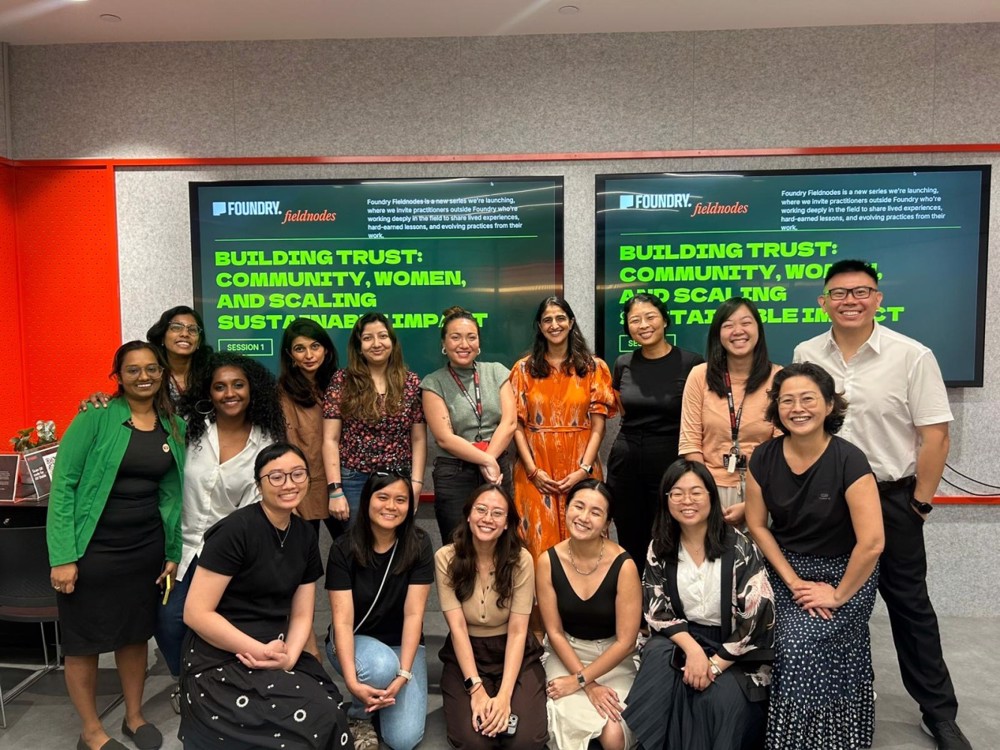
I recently had the opportunity to explore this at The Foundry in Singapore, and interestingly, I didn’t start with an answer. I started with a question. What is already here? Because where you start matters more than we often admit. If you start with what’s missing, you position yourself, often unintentionally, as the solution. If you start with what’s already there, you begin to build with people, not for them. That distinction between deficit and dignity is subtle, but it changes relationship dynamics. And in our experience, that is where trust begins.
This question of trust has stayed with me in part because of a case study we commissioned with Education Futures. We didn’t do it to prove impact. We did it because we wanted to understand something we could already feel: Why was this working?
What emerged was simple, but not easy. Trust wasn’t something we were building towards. It was the condition that made everything else possible. Communities trusted the organisation, Mamas trusted the programme, and parents trusted the Mamas. Over time, that became a self-reinforcing system. But understanding that trust existed was only the starting point.
The real questions were:
Can we build it intentionally? And can we scale without losing it?
Over the years, often intuitively, often messily, we’ve started to see patterns. We’ve come to think of trust not as a single idea, but as a set of conditions that need to be present. People need to feel safe before they trust. Relationships are built through consistency rather than grand gestures. Power shifts depending on whether we start from assets or deficits. And ownership depends on who is truly holding the work. We sometimes visualise this as a “Wheel of Trust”, not as a rigid framework to follow, but as a way to ask better questions of ourselves. Where am I showing up well? Where am I holding too much control? Where am I moving too fast to build real relationships? Trust does not break all at once. It weakens quietly, in the places we are not paying attention to… and we have experienced this too.
What stayed with me most from the session in Singapore, however, was not what we shared, but what I learnt. We had organisations from across the social impact ecosystem in the room, not just early childhood, but across sectors. And again and again, I heard the same thing: the contexts are different, but the patterns are not. In Singapore, as in Botswana, many of the communities being served are invisible in different ways. In both places, government plays a central role, and rightly so. But in both places, there is also a quiet tension. For organisations that sit somewhere in between, not fully charity and not fully commercial, it can be difficult to find where you fit. You fall through the cracks of systems that were not quite designed for you. And in those spaces, trust becomes even more critical.
Because when systems are unclear, when pathways are not obvious, when funding doesn’t quite align… relationships are what hold things together. That was something I didn’t go there to say. That was something I went there and learnt.
There’s also a tendency to talk about trust as something abstract. It shows up in mission statements and values. But in practice, it looks quite ordinary:
It looks like showing up when there is no immediate outcome. It looks like doing what you said you would do. It looks like sitting with someone without trying to fix something. It looks like letting go of control, even when it’s uncomfortable. It looks like respect. Care. Asking about people’s families. Talking about yours. And dare I say it… It looks like Love.
It also looks like slowing down. Which, in our sector, is often the hardest thing to do. We are under pressure to move quickly, to show results, and to scale. But trust does not move at that speed. And if we are honest, the systems around us do not always incentivise trust. They incentivise certainty, outputs, and quick wins. But here’s the tension, without trust, none of those things actually hold.
I ended the session with a question, and I find myself still sitting with it. What would change in your work if trust was the starting point, not the outcome? Not something you hope to build over time, but something you design for from the very beginning. Because if we truly did that, in how we show up, in how we share power, and in how we create ownership, we would not just change programmes. We would change systems. And more importantly, we would change how people experience those systems. That, I think, is what makes trust worth building.